
Important Notice
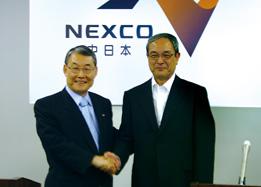
June 27, 2006 Joint press conference with new and old chairmen
Conference Summary
(Moderator)
We will now begin the press conference with the new executives of Central Nippon Expressway Company Limited and former Chairman Kondo, who will be stepping down as of today.
First, at today's first ordinary general meeting of shareholders, Member of the Board of Directors and Audit & Supervisory Board Member were elected, and then at the subsequent meetings of the board of Member of the Board of Directors and Audit & Supervisory Board Member, a representative Member of the Board of Directors, Member of the Board of Directors with titles, and a full-time Audit & Supervisory Board Member were elected.
Hironori Yano, who has been appointed Chairman and Representative Chairperson of the Board will now introduce our new executive officers and offer his continued greetings.
(Chairman)
Hello everyone, nice to meet you. I'm Yano. I look forward to working with you.
Now, I would like to introduce the individuals who were appointed as officers of Central Nippon Expressway Company Limited at today's Member of the Board of Directors meeting.
Today was our first ordinary general meeting of shareholders, where Member of the Board of Directors and Audit & Supervisory Board Member were elected. At the subsequent meetings of the Board Member of the Board of Directors and Audit & Supervisory Board Member, the representative Member of the Board of Directors, Member of the Board of Directors with titles, and full-time Audit & Supervisory Board Member of Central Nippon Expressway Company Limited, Ltd. were elected, as shown in the materials you have in front of you. I would like to introduce these to you.
First of all, I am Hironori Yano, and I have been appointed as Representative Chairperson of the Board. I look forward to working with you.
President is Fumio Takahashi.
The executive Member of the Board of Directors is Yamamoto Masaaki.
The managing Member of the Board of Directors is Beppu Shonosuke.
The managing Member of the Board of Directors is Harada Yutaka.
Tatsuji Takahashi serves as a full-time Audit & Supervisory Board Member.
Audit & Supervisory Board Member.
Although they are unable to attend the press conference today due to commitments, two other auditors, Fumio Kawaguchi and Hiroshi Ishizuka, have been re-elected as part-time Audit & Supervisory Board Member.
I would also like to report that at the Member of the Board of Directors meeting just now, it was decided that former Chairman Kondo would be appointed as an advisor. I look forward to your continued support.
Now, let me give you a brief greeting.
Some of you may have been present when I greeted employees earlier, so please forgive me for any overlap.
What are the current challenges facing NEXCO Central Japan? In a nutshell, we have already drawn up a privatization scheme and business plan, so all that remains is to execute it.
In this case, we will use the PDCA cycle, a concept widely used in the private sector, to improve the content of the plan and strive to achieve results. We believe that by going through this cycle of PLAN-DO-CHECK-ACTION, the initial objectives will become more concrete.
To achieve this, we believe it is necessary to put customers first, gather collective wisdom, adhere to a hands-on approach, and relentlessly advance reform.
It goes without saying, but Expressway projects are projects with a very high public nature. I believe that a company is a public institution for society, and I believe that this is especially true of our company's business.
For this reason, it is only natural that we strive to actively disclose information and increase transparency. Furthermore, without regaining the public's trust, there will be no future development of the business.
We often hear the word "compliance." This refers to "obeying the law." However, while "obeying the law" is a natural obligation for a corporate citizen, it is not enough. From now on, we must quickly move beyond that level, proactively fulfill our social responsibilities, and become a truly useful presence in society.
Although I am truly limited in my contributions, we will work together to realize the business plan established by former Chairman Kondo. Of course, the situation is constantly changing, so we will always strive to respond flexibly and never forget the purpose of privatization as we work to achieve it.
All of us, including executives, senior management, and frontline employees, are committed to working together as one. We would be extremely grateful for your continued support and understanding. We look forward to your continued support.
(Moderator)
Next, I would like to extend my greetings from former Chairman Kondo.
(Counselor)
Apparently Hello, everyone.
As I mentioned earlier, I retired from the position of chairman after having the general meeting of shareholders I mentioned earlier.
In addition, Mr. Yano had a request earlier, "I want to leave a seat as a consultant for a while because I do not know what is going on and what will happen for the time being". At the press conference last time, I said, "I haven't decided anything about the future," but since there was nothing exactly, I thought, "If it will be useful for a while," I was happy to accept it.
However, I will add that this is "for a while".
From now on, I will firmly hand over the new chairman Yano, but before the new chairman says "it is already good", I would like to withdraw myself. It's a difficult place, but for the time being, there will be a solid hand over from this month to the next. I will do this firmly.
Everybody has been with us since I was appointed-since last October and since the founding general meeting at the end of September. I'm really thankful to you.
I joined the public corporation three years ago in November. Since then, everyone in the press has arbitrarily thought that they are our valuable communication partners.
For that reason, I sometimes said unreasonablely and came to me late at night. I have been asked to hold daily interviews. I'm sorry to say that, but I thought that I was a valuable communication partner and asked for a relationship.
It's been 9 months since October in this area, but thank you very much for your help.
As you know, the true shareholders of our company are the people. I think it is of utmost importance for the people, who are true shareholders, to understand as much as possible what we are thinking, what we are doing, and what we are going to do.
We have made various efforts, such as expanding the homepage as much as possible, and talking to us at the previous press conference, but establishing a dedicated information disclosure person. As Chairman Yano told us, the importance of information disclosure is recognized by all executives and employees, and we believe that we can continue to make further efforts.
We are truly grateful for your guidance and encouragement. We would like to thank you again for your kindness to the new chairman.
And I think that I was able to hear your thoughts on my retirement as a greeting from the employee.
If I dare to add, one is a sense of accomplishment that I have been able to do without compromising what I should have done since I joined the corporation three years ago. The other is my happiness that I can leave with a good new chairman, Mr. Yano, who succeeded me, and I would like to share with you two things.
Thank you very much.
(Moderator)
Now, let me turn to Q & A. We are planning to finish the meeting today at 16:20, so please cooperate. So do you have any questions?
(Reporter)
I'm going to ask Mr. Kondo. I think that the president of the public corporation has provided various paths to privatization. Initially, I think that the viewpoint for privatization such as the management of the upper and lower sides was mentioned, but in the end it will be a leasing method, and the nation will have one-third of the shares when privatizing. In such a form, it has not reached the point of complete privatization.
I would like to hear your impression about it.
(Counselor)
I think that you have to answer the questions that are at the very heart of the matter.
The top and bottom are the ones we talked about at the beginning, but there are various shapes. What I most prioritized is the autonomy of the company. I was particular about this when formulating the privatization bill. Therefore, even if the lease method is adopted, we basically want the autonomy to be the same as owning it.
There are various legal requirements. Although there are some conditions, I think that it was possible to secure sufficient basic autonomy. Formally owned by the holding organization, a new company leases and operates it. However, the management entity does it voluntarily including repair and maintenance.
Mechanisms only play a computational role. That's the law. How to actually repair the road, or what to do when changing the design, what to do. These are all the responsibilities of the new company.
Therefore, although it is a form that is separated from the top and bottom in form, the independence as close to the top and bottom as the substance is assured.
So far, there have been various issues such as tax issues. I also thought a lot. Ministry of Land, Infrastructure, Transport and Tourism thought a lot, and the party also thought. After all this is the best. While maximizing autonomy, try to be as free from tax and other negative constraints as possible. I think that I had a good bill.
And then one third, this is important.
This is a Prime Minister's idea that the company will be listed in the future. I think we should aim for listing.
There are many things that must be done before the listing is realized. There are also various conditions that must be cleared. However, overcoming such issues, let's go public and become fully privatized in the future. This is the government's will. It was also the political will of the Prime Minister and others.
At the beginning, there were various ideas. There was a provision that the second draft and third draft of the bill should be owned by the government by half. However, if we aim for complete privatization in the future, it may be a bad idea to keep the majority in the country forever. For the time being, I decided to try to make it one-third.
In a sense, this would require a review of the law at the time of listing. Therefore, the law has an additional rule that it should be reviewed within 10 years. In that sense, it is one-third for the time being.
From now on, we must also raise funds voluntarily. During the process of drafting the bill and deliberation of the bill, I listened to a lot of stories from people related to finance. After all, until the listing is ready and the financial structure is properly established, the government will take some responsibility and own shares as a majority shareholder instead of a majority. I also heard that the financial market would be safer if there was support.
Therefore, in reality, we will start with 100% government investment, until the listing. And within 10 years, we will review the law. It is one-third based on such a premise, and it is the establishment of autonomy.
With this, we decided that we could have achieved the goal of privatization, which was our goal at the beginning, through corporate management with autonomy.
In the process of deliberation of the bill, there were questions from the media at the time, and I answered it as it is now. It was a very important question, so I answered it again.
(Reporter)
It seems persistent, but is it all right to think that there is an idea as the former chairman that one-third of the government holdings need to be reviewed when listing?
(Counselor)
sorry. If not, there is no problem in listing even if there is a third. After all, the majority is bad. Therefore, one third can be listed because the government owns it.
However, in the future, the Prime Minister also says that if you do privatization.
(Reporter)
Doesn't it mean that one-third should be reviewed again within 10 years with the supplementary provisions?
(Counselor)
No, not necessarily. It is supposed to be reviewed within 10 years, so at that time this one-third is still one of the matters to be discussed again at that time, I realize that It means that
(Reporter)
Don't you have a clear time for this?
(Counselor)
I don't know this. That's the law, say within 10 years.
(Reporter)
Regarding leasing, I think that it is possible to record depreciation if it is a normal private lease, but the fact that the side leasing the maintenance cost has a slightly different meaning from the normal lease think. You mentioned that it is a tax issue, but what about that point?
(Counselor)
exactly. It's completely different from a regular lease contract.
As if it owns it, but ownership belongs to the organization. We have an agreement based on such a special law.
(Reporter)
Do you think that is what it should be as a private company?
(Counselor)
I designed it that way and made it into a bill. The current law is the result of maximizing autonomy. Please recognize that way.
(Reporter)
I understand from the current story that it is advantageous in terms of tax law, but what I am not convinced is that it can be called a private company without paying taxes. What do you think about that point?
(Counselor)
I think it's about property tax, but as you know, in the current framework, ownership is a mechanism, so it's a national property. It is not the basic idea of property tax that the state pays taxes on state property.
Also, after 45 years of full redemption, the (asset) will belong to the country. The fact that the state pays property taxes on national assets is not part of the idea of the tax system, so I think that not paying property taxes is not a special inconvenience. Basically, it is the property of the people.
(Reporter)
In the situation where the people's assets are the assets of the main company, can we really say that the company and the country are independent of each other?
(Counselor)
That is where the various discussions took place.
The property of the people is not destroyed. Therefore, is there a way to maximize the autonomy of the road maintenance service business as a company? Therefore, the government and the ruling party had various discussions. As you know, various ideas came up.
Among them, one remains the property of the people. The landowners who provided the land to Expressway did not provide it as the property of one private company, but because it becomes the property of the people.
The spirit of the road will not be changed, and a private company that manages the maintenance and repair of roads will repair it. If you want to manage and pavement, you can maximize your independence. Do not apply to each country and get permission. Secure autonomy as a private company.
The result of various thoughts on how to achieve these two themes is a very special form of lease contract today. It is not a private lease contract. That is the conclusion.
Do you understand that way?
(Reporter)
How will you be involved as a counselor? Also, how long are you looking at the period?
(Counselor)
As I mentioned earlier, there are various handoffs for the time being. I would like to talk about various backgrounds since the days of the public corporation, and to convey various things in various cases.
Also, I don't know what will happen, so at that time I might be able to give some advice based on my experience.
In that sense, if it helps, I would like to help. I know this is my role as a counselor.
As I said earlier, I would like to withdraw the period before the chairman says, "I may quit already." When will it be? I hope it is as soon as possible.
(Reporter)
I would like to ask Mr. Kondo but at the last or last meeting, I think the reason for resigning was something like "just as the minister said" or "I'm still in the informal stage, so I can't say clearly." So, I would like to ask you about the circumstances and reasons why you resigned.
(Counselor)
The reason is as I have stated so far. "I will say it after it is officially decided," I do not say. "I would like to share your impressions at that time," he said.
As I mentioned, my reason for resigning was from the beginning that I accepted it.
Three years ago, Prime Minister Koizumi and Minister Ishihara said, "Until the privatization of the president of the public corporation." After that, the privatization schedule was fixed, and it was privatized in 2005.
After the privatization legislation was enacted, the three companies were divided into specific parts, and when I designed the system of the company, I received the chairman's position with such an promise until it settled as a company. There was such a background. I believe this was understood by me and the appointee as well.
I was thinking that it would be until the conclusion of this agreement, which is the legal preparatory period, and the business planning of the new company. Therefore, we think that we have almost achieved this, so I will resign this time. I think the Minister also said that, and I answered that last time with that in mind.
(Reporter)
I would like to ask the new Chairman Yano. I've heard that there weren't many points of contact with roads, but what kind of career do you want to apply to Central Nippon Expressway?
Then, I think that Chairman Kondo has come as a chairman in a way that stands out as a spokesman. How do you want to position yourself as chairman and president?
(Chairman)
When I was in Toshiba, I used to work near the site. I have been involved in various jobs not only in Japan but also in foreign countries. Through those things, I have learned a lot about what is important in management.
What I would particularly like to emphasize is that I think about things on site. Of course, the company's policy is head office, and it is absolutely necessary to think in the head. However, it is not possible to do without thinking on site.
Moreover, I think there is a need for fear in order to gain the cooperation of many people.
I think there is a limit to what one person can do. There are so many excellent employees that I would like to visit the site and listen to their opinions so that they can fully exercise their abilities.
Then, I think that there is something quite confusing due to the privatization of the Road Authority. To be honest, I think so. I think that corporations and corporations are very different not only in shape but also in content, and I think the difference will become even larger from now on. No matter what it means to be a private company, as long as it is a stock company, it will not stand up if it is mismanaged.
In other words, there is always such rigor, and I think it is a private company's effort to overcome it. I think it would be useful in such a place.
After all, I'm a layman when it comes to technology and various specialized fields, especially road-related matters. I'm receiving lots of lecturing from everyone, but I don't think I'm doing that yet.
I would like to make an effort, but I think that the most important thing for the management of a private company is "people." I think that if the “person” really exercises his / her ability, it will lead to good results. For now, I've only talked about people as employees, but customers are people and business partners are people. In such a relationship, I would like to create a company with a strong presence.
I think Mr. Kondo had the most difficulty in the process of privatizing the public corporation. In such a situation, I took the lead in making a business plan. I don't know how much this is known to the outside, but it was really hard work made in return for Saturday and Sunday, and the plan itself was a gathering of public knowledge. It is necessary to gather public knowledge to execute it. By doing so, the plan itself, or in the process of execution, that is, in the "PDCA" cycle, may change little by little. If there is a major change in the plan, it should be discussed with the appropriate person. But even then, small changes continue to occur. Only by doing so, I think that the mere framework will become flesh. I would like to do such a job.
For the time being, I would like to try my best to hit the pitch.
(Reporter)
I would like to ask Mr. Kondo again. I'd like to feel proud that you have accomplished this task since you were appointed as chairman, and if you think that you have left behind such a job, please. Also, please ask what you want the new chairman to do.
Next, the new chairman talked about "PDCA" earlier, but please explain in detail how this company can apply it.
(Counselor)
I'll answer that question.
First, I would like to ask what we have achieved since October of last year.
First of all, as I mentioned earlier, there are two things that the law stipulates that we must do.
One is the conclusion of this agreement. In essence, within the framework of the repayment period of 45 years, how much of Expressway will the new company be involved in using the toll system? Specifically, which routes will that be? What schedule will be set for repairs, maintenance, and service of those roads, and what will be done?
In particular, many of Expressway in our region are old routes. The Meishin, Tomei, and Chuo expressways, which are unprecedented in the history of Expressway in Japan, and perhaps even the world, will soon be in need of reconstruction or major renovation. They will require maintenance and services unprecedented in the history of the world. The entire company considered how to achieve this over the next 45 years. We pooled our resources and considered the matter, deciding how much we should build on new routes and what maintenance and service policies we should implement. For example, as we declared in Challenge V, we decided to complete all earthquake-resistance reinforcement within five years.
It was under these circumstances that we concluded this agreement. I think it was a good agreement. It was made possible thanks to the efforts of everyone. We listened to the opinions of everyone on the ground, and as Mr. Yano mentioned earlier, we listened to the opinions of everyone on the ground, even on their days off. In this way, we feel that we have been able to come up with a very fine agreement, and that is one reason.
Another thing required by law is a business plan. We have expanded on that to create a five-year plan. We have decided on specific goals to be achieved over the next five years, five years from now, three years from now, and by the end of this fiscal year, as well as who will be responsible for what. A summary of "Challenge V" is available on our website, so I hope you will take a look.
This means that we can see how much progress will be made on which roads over the next five years.
Next, I would like to talk about the remaining issues from the time of the public corporation. We have established 24 measures to prevent bid rigging and other fraud. Everyone offered some very bold opinions, and we have decided on the maximum number of prevention measures possible within the current legal system. We are steadily implementing these measures.
Next is the new personnel system. Until now, we have been using a government personnel system, but from April 1st we have been implementing a personnel system that gradually incorporates the personnel system of a private company, such as a management by objectives plan and performance appraisal system.
Therefore, we have basically completed the framework for transitioning from a public corporation, an administrative institution, to the world of management accounting as a private company, including the personnel system. This means that we have created the systems and framework that a private company must have in place.
The next question is how to use all our strength to achieve this. So, the third question is, what are the challenges?
The issues I have to address are directly related to your question about the transition to the new chairman. There are two. I think I mentioned this a little bit the other day.
First, we have a framework, a business plan. We all need to work together to achieve this. To achieve this, we need to demonstrate our collective strength.
Let me be more specific. As you know, during the time of the Public Corporation, there were two lines: administrative and technical. Now they have been merged. We must further solidify this.
Since then, the new company has welcomed over 200 sales staff to the service areas and other areas previously run by the foundation. We have also hired several dozen new employees from the private sector, including recent graduates. As mentioned earlier, we have also welcomed a new full-time Audit & Supervisory Board Member to our board of directors, and we will likely be integrating these new talent with those from the Corporation.
As I mentioned the other day, our company has two main pillars. One is Expressway business, and the other is related businesses.
We will be expanding into various areas, including opening service areas, etc. We are currently considering various options, including development around the interchange. These two are the pillars of our plan.
These two divisions must work together to create a synergistic effect. Even though we are talking about related businesses, we won't see any effect unless we integrate the card business and Expressway business.
In that sense, there will be a need for integration between business divisions. In that sense, we will need to demonstrate our comprehensive strength. That is the challenge.
And as a prerequisite for achieving this, as I mentioned last time, a change in awareness is absolutely necessary.
There are many different meanings behind the phrase "change in mindset." One is something I mentioned quite a bit in my closing remarks to employees earlier, and I'm sure you're tired of it, but it basically comes down to social responsibility. We must not tolerate dishonesty; that is the foundation. As the new Chairman Yano said, this is the most basic of the foundations.
Based on this, how should we think about social CSR and compliance? This is surely one aspect of changing our awareness.
Another thing is cost and cost consciousness. It has come from the world of budgeting to the world of management accounting. Everyone understands it as a system, and they understand it intellectually. But whether they understand it in their "soul" is yet to be seen.
In short, money costs money. Time costs money. It's a completely different world from the world of budgets. There's an issue of cost consciousness.
And as Chairman Yano said earlier, the customer comes first. What is in front of our eyes? Our customers, the people who are our true shareholders. This is a given for a private company.
What we look at is not the government. The government is an agent of the people. Through the existence of the government, our true shareholders are the people. Our eyes are on the people, our customers.
Frankly speaking, I think we have made considerable progress in these three reforms of mindset, but I also believe we are only halfway there. In that sense, I would like to firmly hand over to the new Chairman Yano the two I just mentioned - "Demonstrating our collective strength" and "Reforming our mindset."
Is that okay?
(Chairman)
This is a question for me.
P of "PDCA", I think this is "Challenge V". Those who build and operate roads have a very specific plan over the past five years, but related businesses are still in the future. I think that various ideas are included, and all hints are hidden in it, but I still think that this related business, SA / PA, is a treasure trove.
I really want to do my best to collect ideas. I mentioned it as public knowledge, but I think that this should be heard not only by the public knowledge of employees, but also by the opinions of outside experts with a high degree of expertise.
I am preparing with that in mind, but this will also enhance the plan itself, and even while I am in the execution stage, new ideas will come out and the plan will grow.
In the old days, the word "PDS" is no longer used in "QC" (Quality Control) and quality control. PLAN-DO-SEE. The basic idea of recent thinking is that just looking at it will not do anything, and it will be linked to ACTION by CHECK, and then it will be fed back to new plans. I think it is important for everyone to experience the process.
Then, small success will lead to the next "greater success". If that really goes on track, I think this business will work.
The business field with the highest degree of freedom is the related business field, and I think this is truly a treasure trove.
If you have any opportunity, please visit SA / PA and let me know, so I would be grateful if you could come up with various ideas.
Then, I said that I didn't answer the question I mentioned earlier, and although this is a conference, I would love to continue. I myself would like to attend this session and exchange opinions with you and have a Q & A session.
I think that each time I meet, I think that my knowledge and experience will become more abundant, but in that sense, I would appreciate it if you could give me some time.
(Moderator)
Since the scheduled time has passed, this is the end of the question and answer session. It was to be noted that the photographer just wanted to ask the new and old chairmen to shake hands.
(New and old chair shaking hands)
(Chairman)
Thank you very much.
(Counselor)
Thank you so much for everyone.
