
Environmental initiatives
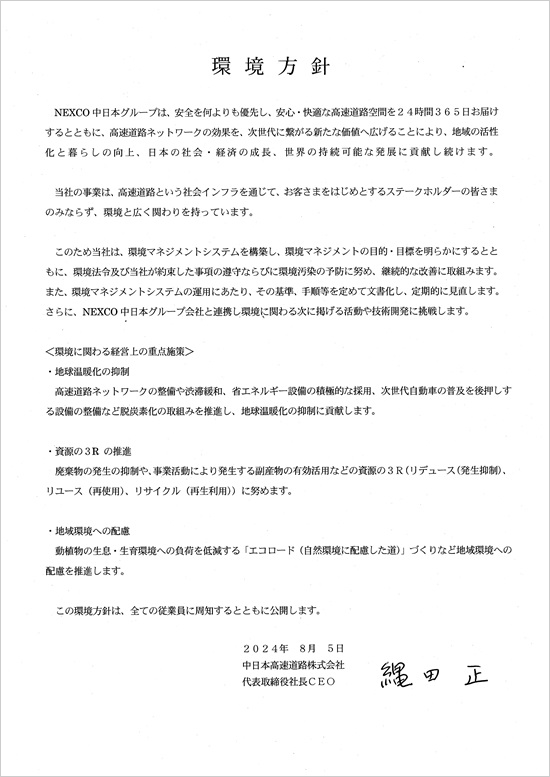
NEXCO CENTRAL Has established an environmental policy, and through its business activities, has been working on the prevention of global warming, the promotion of 3R resources (reduction (reduction), reuse (reuse), recycle)), and consideration for the local environment is.
Suppressing global warming
Central Nippon Expressway Company Limited Limited Road Decarbonization Promotion Plan
Due to the effects of climate change caused by global warming, there are concerns about the increasing severity and frequency of natural disasters, making the promotion of climate change countermeasures an urgent issue requiring a global response.
NEXCO CENTRAL has set the mitigation of global warming as one of its key management measures related to the environment in its "Environmental Policy," and is promoting business activities with SSEG (Safety, Social, Environmental, and Governance) as a key theme in its CSR activities.
Furthermore, taking into account domestic and international developments, and in order to promote the reduction of CO2 emissions in the supply chain, we formulated the "Central Nippon Expressway Company Limited Road Decarbonization Promotion Plan" in March 2026, aiming to achieve decarbonization by 2050.
NEXCO CENTRAL Group will continue to contribute to environmental conservation, including decarbonization, through its business activities.
- Central Nippon Expressway Company Limited Limited Road Decarbonization Promotion Plan (Main Text)
- Central Nippon Expressway Company Limited Limited Road Decarbonization Promotion Plan Overview
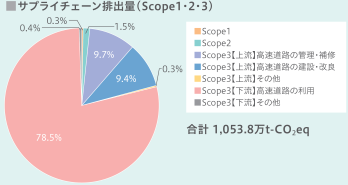
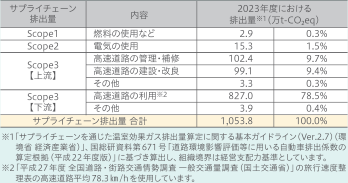
NEXCO CENTRAL Group Greenhouse Gas Supply Chain Emissions (FY2023)

[CO2 Reduction in the Road Management Sector (Scope 1 & 2)]
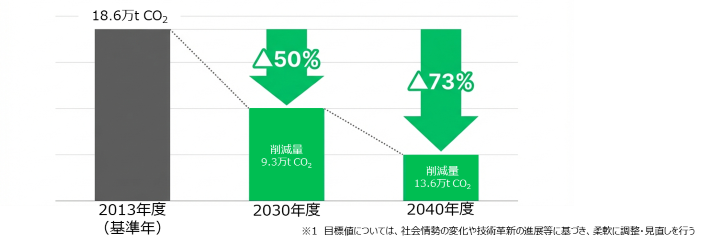
Our group aims to reduce CO2 emissions in the road management sector, which combine direct emissions (Scope 1) from our own fuel use and indirect emissions (Scope 2) from electricity use, by 50% by fiscal year 2030 and by 73% by fiscal year 2040 compared to fiscal year 2013.
Electrification of road-related vehicles
We will replace company cars and management vehicles with electric vehicles, except in cases where there are no suitable alternative electric vehicles, in order to reduce CO2 emissions during operation. We aim for 100% replacement by fiscal year 2030.
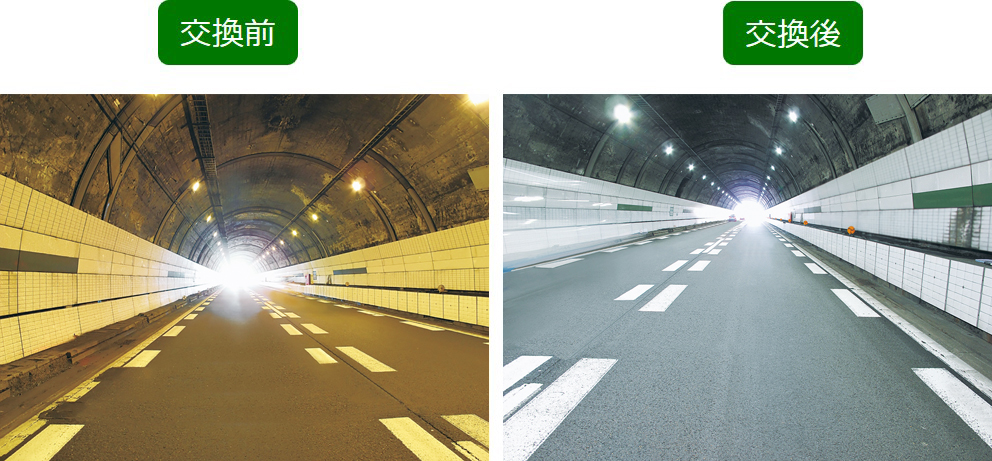
LED lighting for road lighting and interior lighting in company buildings, etc.
We are reducing the power consumption of lighting fixtures by replacing sodium lamps and other types of lamps with high-efficiency LED lighting fixtures for road lighting, tunnel lighting, and interior lighting in company buildings and other structures. We aim to achieve a 100% LED conversion rate by fiscal year 2030.
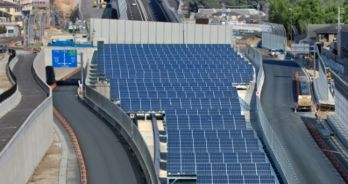
Utilization of renewable energy
We are using renewable energy sources such as solar power to generate electricity for rest facilities and road infrastructure, thereby reducing CO2 emissions. We aim to increase the proportion of renewable energy used for road management to 60% by fiscal year 2030 and to 80% by fiscal year 2040.
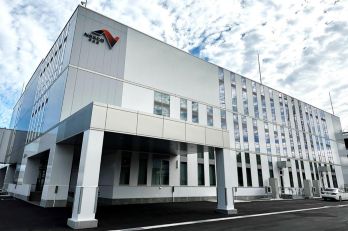
New Building Zero Energy Building (ZEB)
Newly constructed company buildings (office buildings, toll booths, restrooms, commercial facilities) will, in principle, be at least equivalent to ZEB Oriented, and the goal is to achieve ZEB Ready equivalent on average for all new buildings.
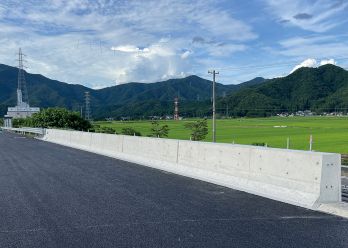
[CO2 Reduction in the Road Development Sector (Scope 3 Upstream)]
We will work towards decarbonizing the supply chain for construction materials and other supplies that we procure for the construction and management of Expressway.
Introduction of medium-temperature asphalt
We will develop internal technical standards and promote the use of medium-temperature asphalt so that 6% of the asphalt mixtures used within our service area can be replaced with medium-temperature asphalt by fiscal year 2030.
*Medium-temperature asphalt is a technology that reduces the manufacturing and application temperature of asphalt mixtures by approximately 30°C compared to normal, contributing to CO2 reduction and shorter traffic control times.
Introduction of environmentally friendly concrete
Aiming for carbon neutrality by 2050, we established the "Environmentally Friendly Concrete Design and Construction Management Guidelines (Low-Carbon Concrete Edition)" in fiscal year 2023. We will continue to promote its use.
*Environmentally friendly concrete refers to concrete that reduces CO2 emissions by 40% or more compared to conventional concrete.
[CO2 Reduction in the Road Use Sector (Scope 3 Downstream)]
We will implement measures to reduce CO2 and other emissions from customer vehicles using Expressway within our service area.
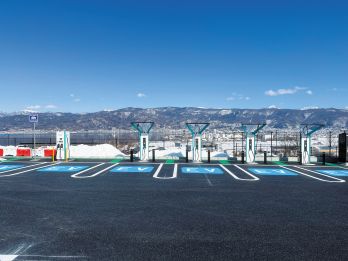
Development of EV fast chargers at rest areas
We are working to develop and upgrade fast chargers on Expressway to accommodate the increasing popularity of electric vehicles.
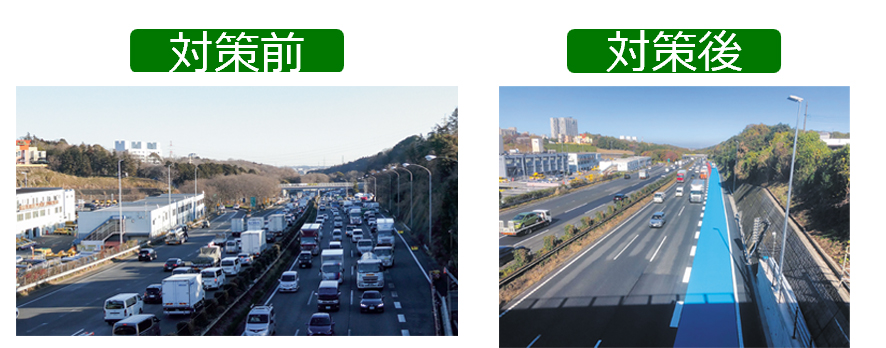
Congestion measures
Traffic congestion not only results in economic losses due to disrupted travel schedules, but also leads to increased CO2 emissions from vehicles due to reduced speeds and repeated stopping and starting. Therefore, we are implementing measures to alleviate congestion, focusing on areas with severe congestion.
Promotion of 3Rs for resources
To minimize the environmental impact of Expressway construction activities, we are working to reuse resources and promote the recycling of construction by-products generated during construction, as well as bottles, cans, and plastic bottles collected during road cleaning.
Green recycling
We recycle plant waste generated from pruning trees and cutting weeds along Expressway into compost and mulching materials. The compost is used as a soil conditioner when planting, and the mulching material is effectively used for weed control on slopes and other areas. The recycling rate in fiscal year 2024 was 98%.
Recycling materials generated during cleaning
We separate garbage, earth and sand, and other waste generated by Expressway cleaning, and recycle items that can be recycled, such as glass bottles and PET bottles. Items that cannot be recycled are properly disposed of in accordance with the Waste Management and Public Cleansing Law.
Consideration for the local environment
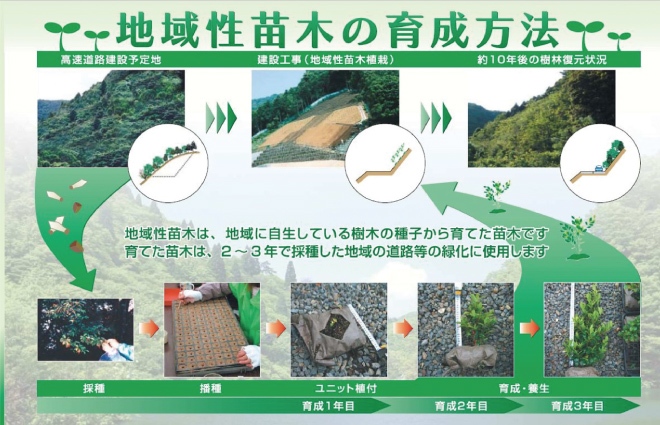
Tree planting by local seedlings
In sections of roads that pass through areas rich in natural environments, we are implementing a greening method in which we collect seeds of trees that grow naturally at construction sites and other locations, cultivate them as locally adapted seedlings, and plant them on the slopes Expressway. To date, we have planted a total of approximately 890,000 locally adapted seedlings.
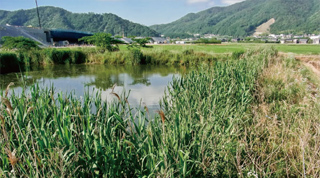
Creating eco-roads (roads that consider the natural environment)
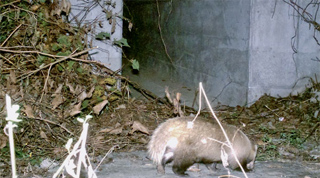
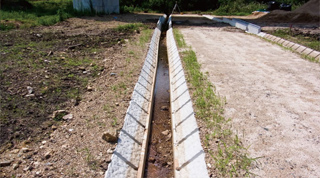
The construction of Expressway risks destroying the habitats and growth bases of surrounding flora and fauna, and disrupting animal migration routes. We are working to conserve biodiversity through the creation of eco-roads (roads that take the natural environment into consideration), such as creating biotopes that artificially restore the habitats of flora and fauna, installing pathways that serve as animal trails, and adopting waterway structures that allow small animals to crawl out if they fall into waterways.
Explanation
A biotope is a habitat created or restored so that animals and plants can live forever.

Acquired ISO14001 certification
NEXCO CENTRAL has established an Environmental Management System (EMS) and manages its environmental activities company-wide by implementing a PDCA cycle for environmental activities.
ISO 14001 certified
