
Result announcement of the 15th Expressway and Landscape Photo Contest


Thank you very much for many applications.
After a strict examination, we selected the winning works.



Masao Torii: Photographer / Kayo Aoyama: Freelance announcer / Toshiji Komuro: President of NEXCO CENTRAL (random order, titles omitted)

Masao Torii: Photographer
The 15th judging session is more exciting than usual. From works that challenged with light footwork to works by veterans who made full use of advanced techniques, many spring, summer, autumn and winter were lined up in the narrow venue. Spectacular!
■Theme 1 "Expressway and Four Seasons Scenery"
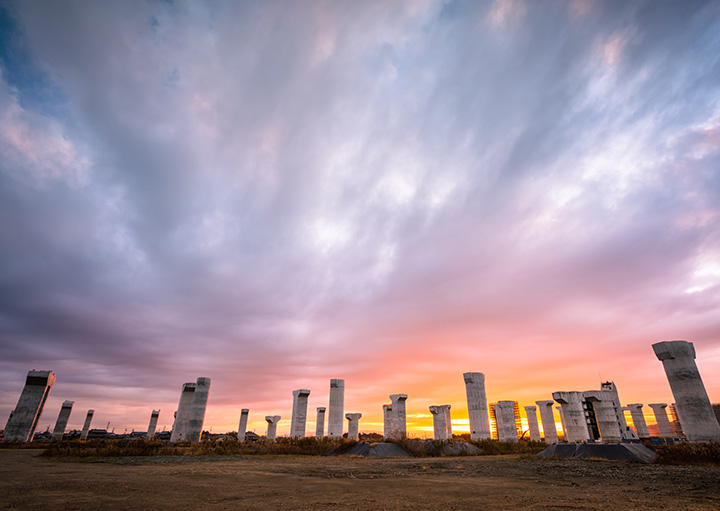
The winner was Yumi Tokuda's Gifu Stonehenge. This work captures the bridge pier construction site of Tokai-Kanjo Expressway IC in progress. It is a precious scenery that can be seen only in a limited period during the construction. Under the vibrant sunset sky, the unfinished piers are elegantly and beautifully rendered, reminiscent of ancient European ruins. The choice of lenses is also accurate.
The winner (Spring) was Ryota Suzuki's "Connecting the Sea to the Mountain." A view of Suruga Bay from a tea plantation on a mountain slope. In the twilight, the lights on the city streets around the coast are full of activity, and the tracks of Shin-Tomei Expressway cars are beautiful. The details such as the tea plantation are well expressed.
The summer winner was Atsushi Ogasawara's Return Dyed in the Sunset. The scene is deeply moving. Perhaps it is the magic of the oblique sunset, but the fact that he faced each other head-to-head, "adding nothing and subtracting nothing," makes this work stand out even more.
Fumio Harada's Asayake Arrows Bridge won the top prize in autumn. The Arrows Bridge itself is a bridge with a unique design, but I am attracted by the powerful screen composition of the author. Under the bluish sky, the red of the bridge piers, dyed by the morning glow, stands out. It's interesting that it looks like people are putting their hands together and radiating energy from multiple red wires.
The winner of the Winter Prize was Takao MIZUNO's The Path of a Cold Night. The trail of red taillights heading toward the Tateyama Mountain Range, the hot steam coming out of the chimneys in the factory area, and the coldness as if everything was instantly sucked into the cold air. The tripod must be freezing.
In addition, four honorable mentions and two winners were selected.
Honorable mention: Kazumasa Yatsu's "Oishii Sanrenpu." The relaxed expression caught my eye. The main tower of the three bridges seen at the end of the arch. I see. Triplet is a fun work.
< Honorable mention > "August no torrent" by Tatsumi Yamashita. Kasagumo on Mt. Fuji that rarely appears. In front of me, I can imagine the strong flowing Fuji River, and the wave of the river is still and lively. The screen composition is skillful, and I can feel the taste of a veteran with a long career.
"Giant Ship Goes" by Yasunori Iwatsuki. Perhaps due to the effect of the telephoto lens, the silhouette of the Triton Bridge in the sunset is interesting. Then a huge ship piled up. It looks like you are looking at a shadow picture with a complicated outline.
< Honorable mention > "The Way Home" by Rintaro Akima. To the setting sun. It's a scene that makes you want to take a picture. It's like watching a movie.
Nominee: Makoto Yoshimura's New Highways. a huge dinosaur that appears in Hokuriku Expressway (Nanjo SA). An eye-catching work with unique color tones under mercury lamp lighting. By the way, it also moves.
Winner: Yasushi Iwaasari's "The Aorta That Takes Over." Four snow plows are used together. Snow removal work on the five-lane Tomei in winter. It is a document of a logical convoy of cars, and how they lead a crowd of ordinary cars to safety.
■ About Theme 2 "Your Best Scenery Category"
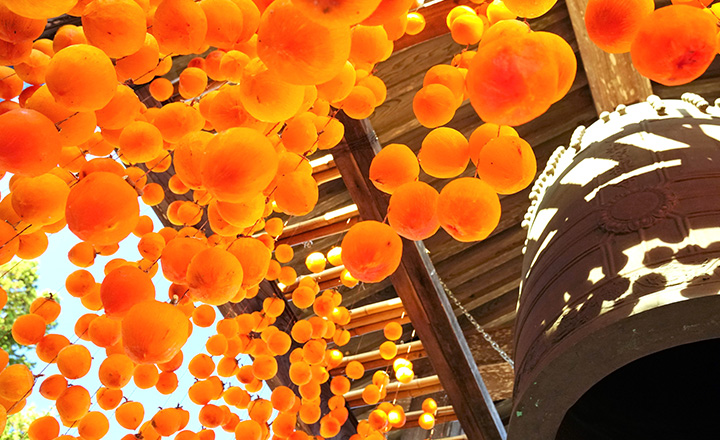
Kaoru Hase's "Persimmon Scenery" won the Grand Prize. You will be overwhelmed by the dance of colorful dried persimmons. The area seems to be very famous for the production of dried persimmons, and the temple bell casts a shadow on it, recognizing it as a temple. The famous haiku by Masaoka Shiki came to my mind without even thinking about the place.
<Award for Excellence> (Spring) was Masayuki Ikemiya's "Cherry Blossoms at the Bridge of the Pieces Shining in the Moonlight". A famous cherry blossom viewing spot that is over 450 years old. Under the falling stars, it has a strange atmosphere that completely changes from the peaceful expression of the daytime. The swirl of flower petals floating in the paddy field in the foreground is also interesting.
<Excellence Award> (Summer) was Yuko Murasakigami's "Sunshine Bridge in Midsummer". A depiction of a straight bridge that seems to melt at any moment under the scorching sun of midsummer. The fish-eye lens effect makes it look like you're looking through a door scope, making it a work full of mischief.
<Award for Excellence> (Autumn) is Mr. Yukio Hayakawa's "Confetti Ranbu". The Koromo Festival is one of the most famous festivals in the Mikawa region. The back view of the hanten-clad caretaker behind the floats while the yellow confetti is flying is very stylish.
<Award for Excellence> (winter) went to Mr. Tsuneo Tsunoda's "Shirotori Lake." A flock of Shirotori resting on the calm surface of the lake. The madder color is beautiful. If the Shirotori dancing like a ballet stage were depicted, the world might have turned out differently.
In addition, 4 honorable mentions and 3 prize winners were selected.
<Honorable Mention> "Spring Gojo River" by Nobuo Kuriki. A tradition of spring where the paste of carp streamers is washed away by hand-dyed craftsmen. Both sides of the river are lined with beautiful cherry blossom trees, and the blizzard of cherry blossoms is flowing on the surface of the river. By adding a sense of life, it will change into a more attractive landscape. The color of the carp streamers is also beautiful.
<Honorable Mention> Satoru Kawai's "The Arrival of Summer". The Shonai Tourism Festival colors early summer. Against the backdrop of the fireworks dancing in the night sky, the majestic lanterns “Yotaka Andon” rise up. The sight of red-based colors clashing against each other is a must-see.
<Honorable Mention> Yuya Ito's "Gassho-zukuri Closed in the Winter Mountains". It seems to be a different village from the famous Shirakawa-go called Ainokura Gassho-zukuri Village. A closed village surrounded by snowy mountains. The scene lit up in warm tones is like the decoration of a decorated cake for Christmas.
<Honorable Mention> "Grand Icefall" by Tatsuyuki Iwahara. An ice art where everything, including waterfalls, freezes under severe low temperatures. Yokoya Gorge in Chino City where the temperature continues below freezing even in February. It is a landscape that shows the power of nature. Hats off to the author who is older than me.
<Selected> Masayuki Takeoka's "Moss phlox on the Meiho Seseragi Kaido". Spring in full bloom! is. Shibazakura is said to have been planted steadily by a single woman for about 50 years. It's a half-hearted beauty. We who are watching this work also feel happy just like the couple on the screen.
<Selected> "Late Autumn" by Yoshito Matsuura. The autumn foliage that burns in the form of a waterway is splendid. The light-up effect is also effective, and the vivid atmosphere reflected on the surface of the water is also interesting. I would also like to see a framing that focuses on the surface of the river.
<Selected> Tatsuya Fukano's "Clear Morning". The mountains in the distance line up beautifully. Whether it's the early morning of winter or whether the trees on the slope in the foreground are covered with hoarfrost or frost, it looks like flowers are blooming. There is a tendency to focus on the sea of clouds, but I feel the author's unwavering point of view.
I am grateful that I was able to meet a wide variety of "spring, summer, autumn and winter" through the judging committee.
Masao Torii

Kayo Aoyama: Free Announcer
Central Nippon Expressway Photo Contest 2022 Comments
This time of year, which I have been looking forward to, has arrived. This year, many of the works were shot in the near future, and I can imagine that everyone is facing the coronavirus, returning to their old lives, moving from place to place in search of beautiful scenery, and capturing the scenery on camera. Thank you to those who have sent it every year and to those who have taken on new challenges. I want to make the coming year a good year with my dreams in my heart.
What I felt as a feature of this year's competition was that there were many wonderful works that set the nightscape as the stage. There are many excellent works, whether it is a Expressway or a work that reflects the four seasons, and the fantastic scenery woven by light made me scream happy because I was worried about the judgment.
As I write in my reviews every time, along with the excellence of the work itself, I will choose a variety of works to be published in the calendar. The colorful works, gentle pastel tones, and the world of monotone ink paintings will be interwoven, but there are genres and seasons that conflict depending on the year. It's strange, isn't it?
Mr. Torii makes appropriate comments on individual reviews every year, so I will comment from a slightly different point of view.
This time, I came across a work that makes me wonder if it is possible to shoot the structure of a Expressway as a fantastic landscape. It is "Stonehenge of Gifu" which became the best work.
"Where is this place?" "Where do you see this scenery from?"
In fact, it seems that it is a place that has become a hot topic on the street, and its name is exactly "Gifu's Stonehenge". At first, it became a hot topic in the local paper, and now it seems that it is also being featured in the national paper.
When I saw the work, I wanted to go to that place.
That place was the construction site of the Gifu Interchange on the Tokai-Kanjo Expwy. Around the end of last year, piers that will serve as interchanges began to be erected, and in March of this year, 74 piers were lined up.
The scenery that stands side by side on the flat land is exactly like Stonehenge! People at the site were surprised that the sensibility to liken a familiar structure to Stonehenge was "scales from the eyes". Who gave you this nickname?
And the bridge piers are beautifully captured in the subtle rays of the setting sun. We actually moved from place to place with a photo in hand, looking for where the photo was taken. It was a lot of fun working with the people in the field. But just by projecting normally, it will never become that composition. What kind of day was that mysterious gradation of light rays taken? I would like to ask the author once.
It is a sight that captivates the hearts of those who see it, but construction is progressing smoothly, and bridge girders are being built over Stonehenge. By the way, the actual Stonehenge also has something like a bridge girder, so perhaps the most similar scenery to Stonehenge is "now".
It's a pity that we won't be able to see this scenery soon after the construction progresses, but I hope that the bridge girders will be connected and connected as a Expressway as soon as possible, carrying people's thoughts and goods and connecting the area.
Corona is also Large the infection again, but I want to resume moving and traveling while taking good care of myself. I really hope that you will take photos with impact that will make you want to actually go and find the place.
I would be happy if you could look at the calendar in the coming year and have a good year while thinking about your own way. Happy new year to all of you.

