Achieving high performance in response to severe site needs for RC slab repair
- repair
- Road companies and local governments
- Conservation and maintenance company
- construction company
- Construction consulting company
- Longer lifespan
overview
In recent years, road RC decks have been subject to frequent repairs due to deterioration caused by fatigue due to repeated wheel loads, salt damage, carbonation, frost damage, etc. The causes of repeated repairs are a decrease in the interfacial adhesion of the repaired cross-section, shrinkage of the repair material, and differences in properties such as compressive strength and elastic modulus compared to the existing deck.
The PD Method (Perfect Deck Method) is a cross-section repair method that meets on-site needs by setting various performance standards for cross-section repair materials, improving durability and enabling construction that meets on-site repair scope and time constraints.
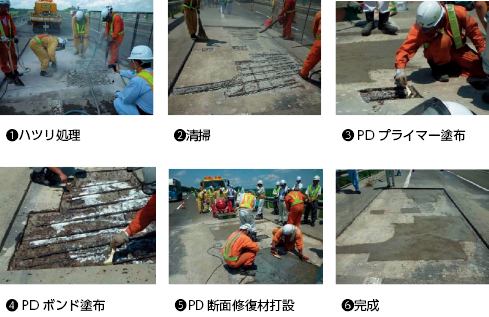
In addition, the PD method is a highly durable cross-section repair method that can firmly integrate the existing concrete with cross-section repair materials by selecting three types of materials depending on the repair case: PD Primer (penetrating epoxy resin adhesive), PD Bond (two-component epoxy resin joint adhesive), and PD cross-section repair materials (Gumlate series, Jet Slab series).
point
Features
|
Excellent penetration |
The PD primer penetrates fine cracks (less than 0.2mm) and strengthens the concrete surface (water jets are not required when hanging). |
|
Excellent adhesion |
PD bond has early bond strength and high bond strength, and integrates concrete and section repair material firmly. |
|
Excellent workability |
PD cross-section repair materials (Rubber Latte Series, Jet Slab Series) are premixed, so they are easy to install, have excellent early compressive strength development, and can be opened to traffic in a short time. |
|
durability |
It has excellent dimensional stability and can be integrated with existing floor slabs, and exhibits excellent durability due to its deformation followability, freeze-thaw resistance, and salt-blocking properties. |
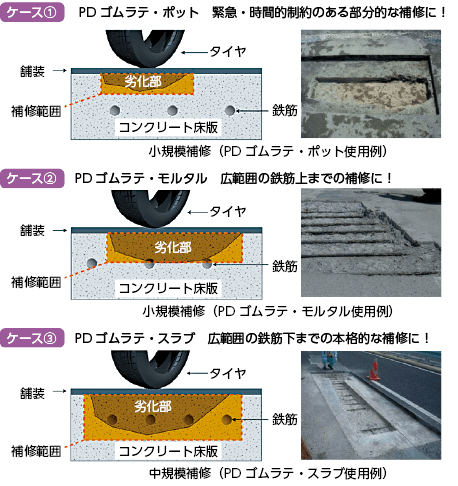
Repair of three cases according to deterioration
Construction procedure